Managing software complexity through business logic isolation
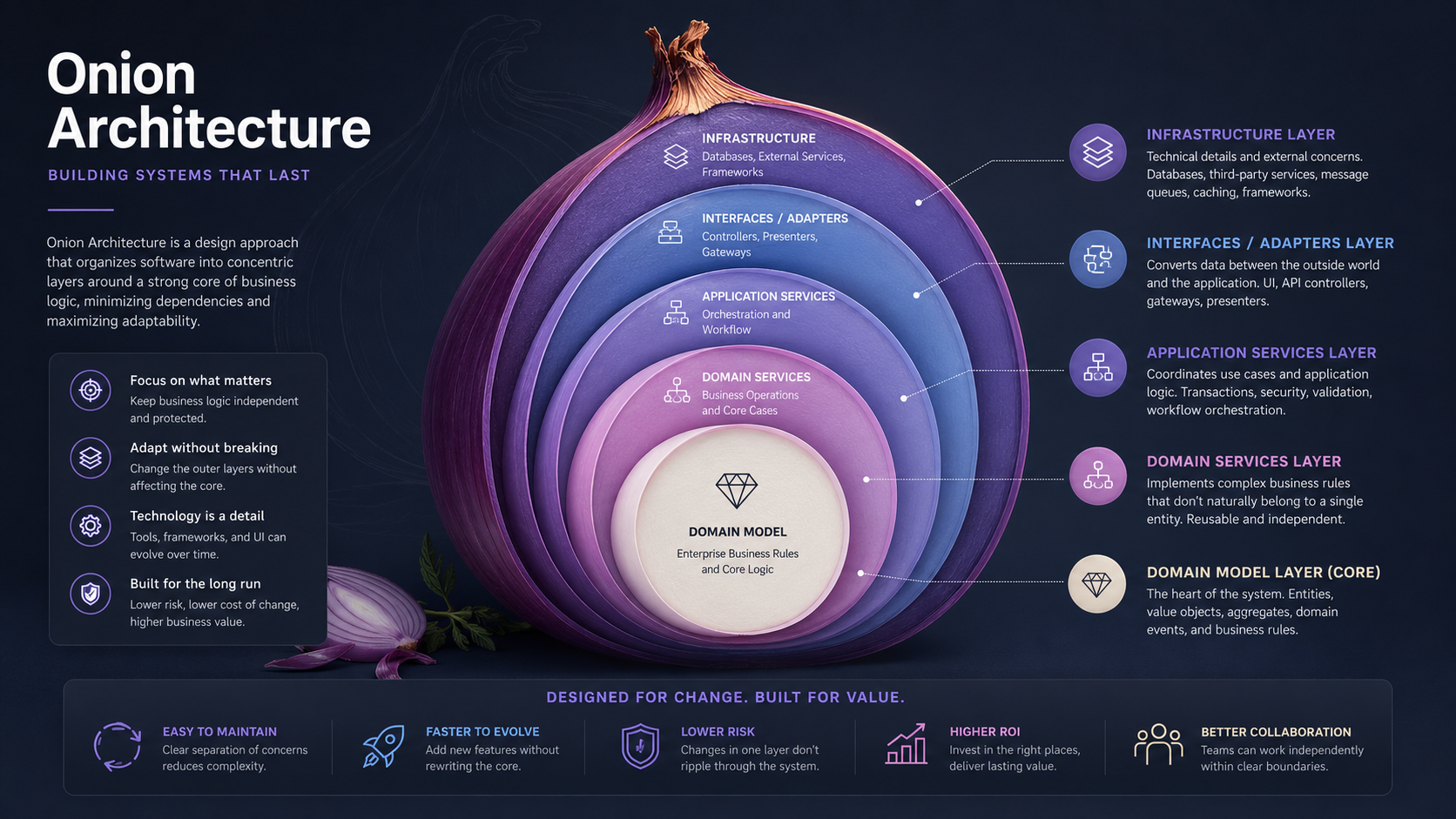
Onion Architecture is an approach to software system design in which business logic becomes the central and most protected part of the application. All external components such as databases, web interfaces, APIs, message queues, and third-party services are treated as pluggable elements around the system core. The primary goal is to ensure that infrastructure changes have minimal impact on business logic and do not destroy the internal application model. This approach is especially relevant for ERP, CRM, SaaS platforms, and other long-lifecycle enterprise systems.
Traditional layered systems often faced the problem of strong dependency between business logic and infrastructure. Domain code gradually became dependent on ORM tools, frameworks, HTTP requests, and database structures. Over time, such systems became difficult to maintain, test, and scale. Any infrastructure change triggered a chain reaction of modifications throughout the application.
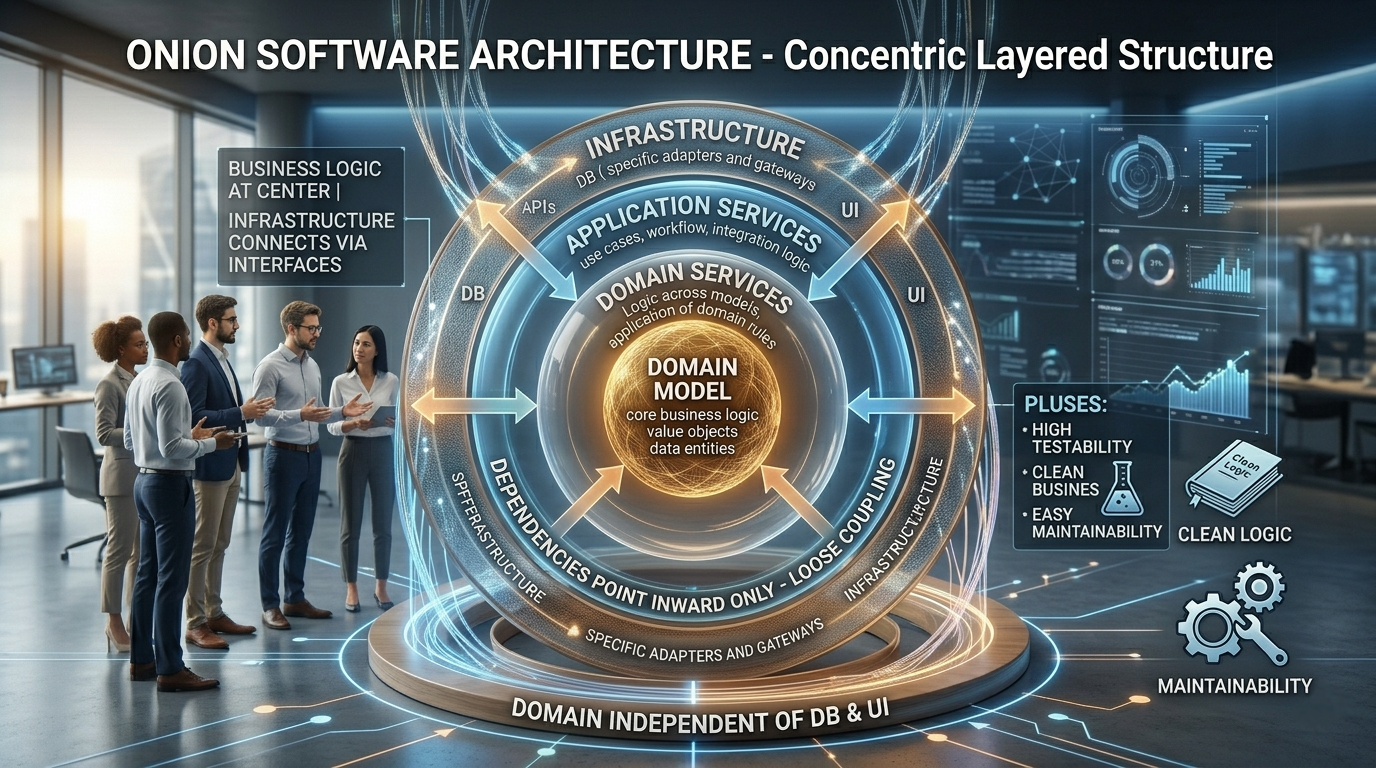
The term “Onion Architecture” comes from the visual model of concentric layers resembling a sliced onion. At the center are the domain model and business rules. Around them are application, interface, and infrastructure layers. The key rule is that dependencies always point inward — outer layers may depend on inner layers, but never the opposite.
Central core - domain model
At the center of the architecture lies the domain model — a representation of the real business through entities, rules, constraints, and processes. This is where the core value of the system resides. For ERP systems, these may include orders, customers, contracts, warehouse operations, financial documents, and business workflows. The domain core should not depend on data storage technologies or user interfaces.
Application layer
The next level is typically the application layer — the layer of system use cases. It coordinates the domain model, manages transactions, orchestrates processes, and handles interactions between services. User actions and business operations are described here without coupling to specific interface technologies.
Infrastructure layer
The outer layers contain infrastructure: databases, file systems, APIs, SMTP services, message queues, Docker containers, cloud services, and integrations with external platforms. These components are considered replaceable. If a company decides to move from MySQL to PostgreSQL or replace RabbitMQ with Kafka, the system’s business logic should remain unchanged.
Dependency Inversion
A key principle of Onion Architecture is the Dependency Inversion Principle. Inner layers define interfaces, while outer layers implement them. This keeps business logic independent from concrete implementations. For example, the domain model may use an order repository interface without knowing whether data is stored in MySQL, PostgreSQL, Redis, or Elasticsearch.
Connect with Domain-Driven Design
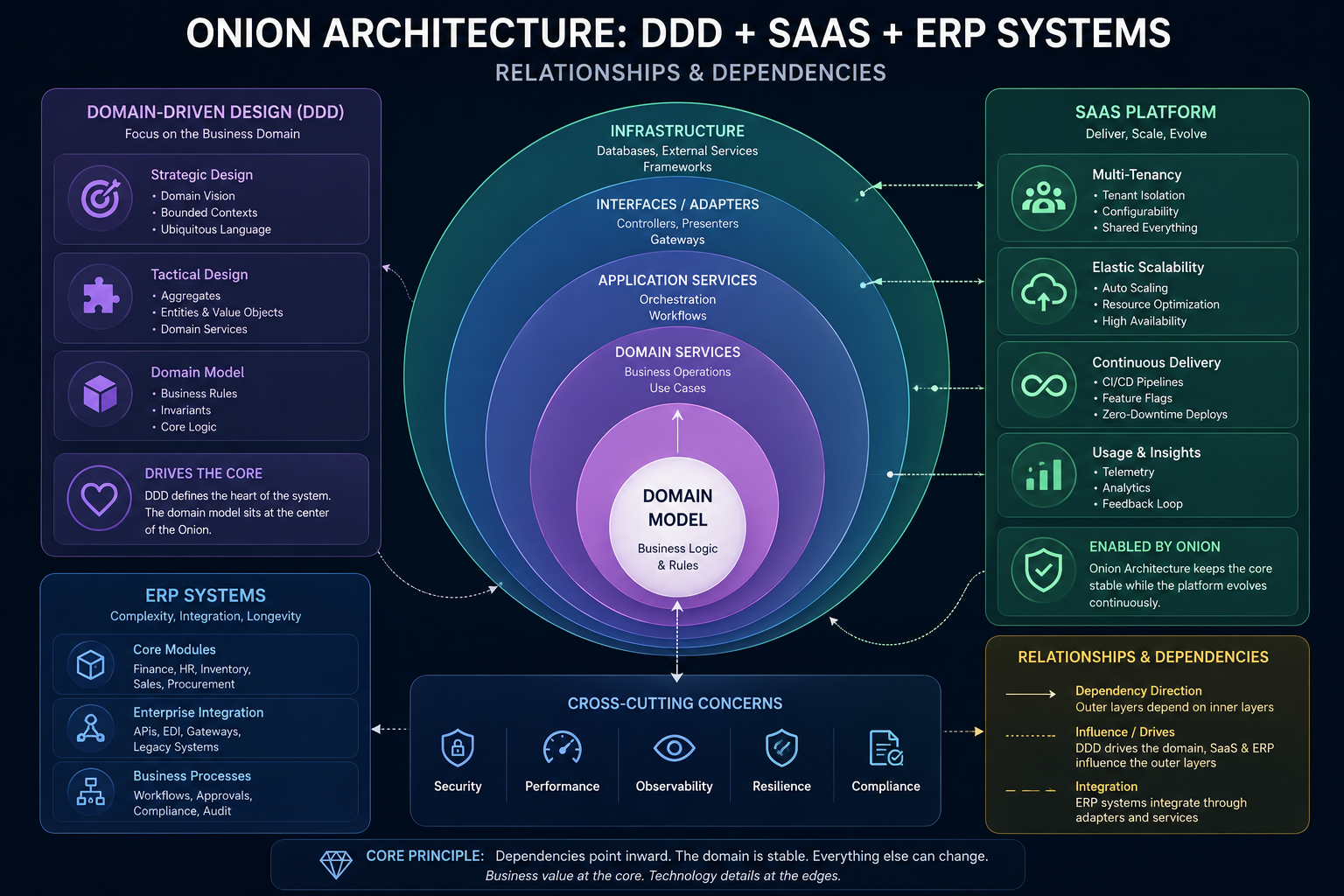
Onion architecture is closely related to the concepts of Domain-Driven Design. Both methodologies place the subject area at the center of the system. This is especially important for complex enterprise solutions, where business rules are much more complex than the technical infrastructure. The architecture begins to reflect the actual structure of the business, rather than the structure of the technologies used.
Onion Architecture, Domain-Driven Design, SaaS, and microservices are essentially different layers of the same strategic idea — building systems capable of evolving without disrupting the business itself. DDD shapes the business domain model and describes real operational processes in the language of the company, Onion Architecture isolates that business logic from infrastructure complexity, microservices allow independent scaling of individual domains, and SaaS transforms the product into a continuously evolving digital platform. Together, these approaches create an architecture focused not only on software development but also on long-term business resilience, adaptability, and reduced cost of change.
In ERP and enterprise SaaS systems, this becomes especially critical because such products often live for decades and continuously adapt to new markets, regulations, integrations, and business models. Architecture stops being merely an internal engineering implementation and becomes part of the company’s business strategy. The easier a system absorbs change, the faster the organization can adapt, scale, and maintain competitiveness. This is why modern architecture is increasingly viewed not as a technical asset alone, but as an investment in resilience, manageability, and continuous business evolution.
From the Kaizen perspective, Onion Architecture is viewed not as a fixed technical structure but as an environment for continuous digital product and business evolution. Isolating business logic from infrastructure enables teams to improve interfaces, services, integrations, and internal processes incrementally without disrupting the entire system or losing accumulated value. For designers, this creates a more stable user experience and predictable product evolution; for product teams, it accelerates the delivery of new capabilities; and for investors, it reduces the cost of change and lowers long-term technological risks. As a result, architecture evolves from a purely technical implementation into a strategic instrument for sustainable growth, scalability, and adaptation to constant market change.
“Philosophy Kaizen”