Practical Architecture for ERP, CRM, FinTech, and Internal Systems
Layered Architecture is one of the most well-known and widely adopted software design models. For decades, it has served as the foundation for enterprise systems, ERP platforms, CRM solutions, banking software, and internal business applications. Its structural simplicity, clear separation of responsibilities, and relatively low entry barrier made it a practical standard for many IT teams. Even today, despite the popularity of microservices, event-driven systems, and hexagonal architecture, the layered model remains the backbone of countless modern applications.
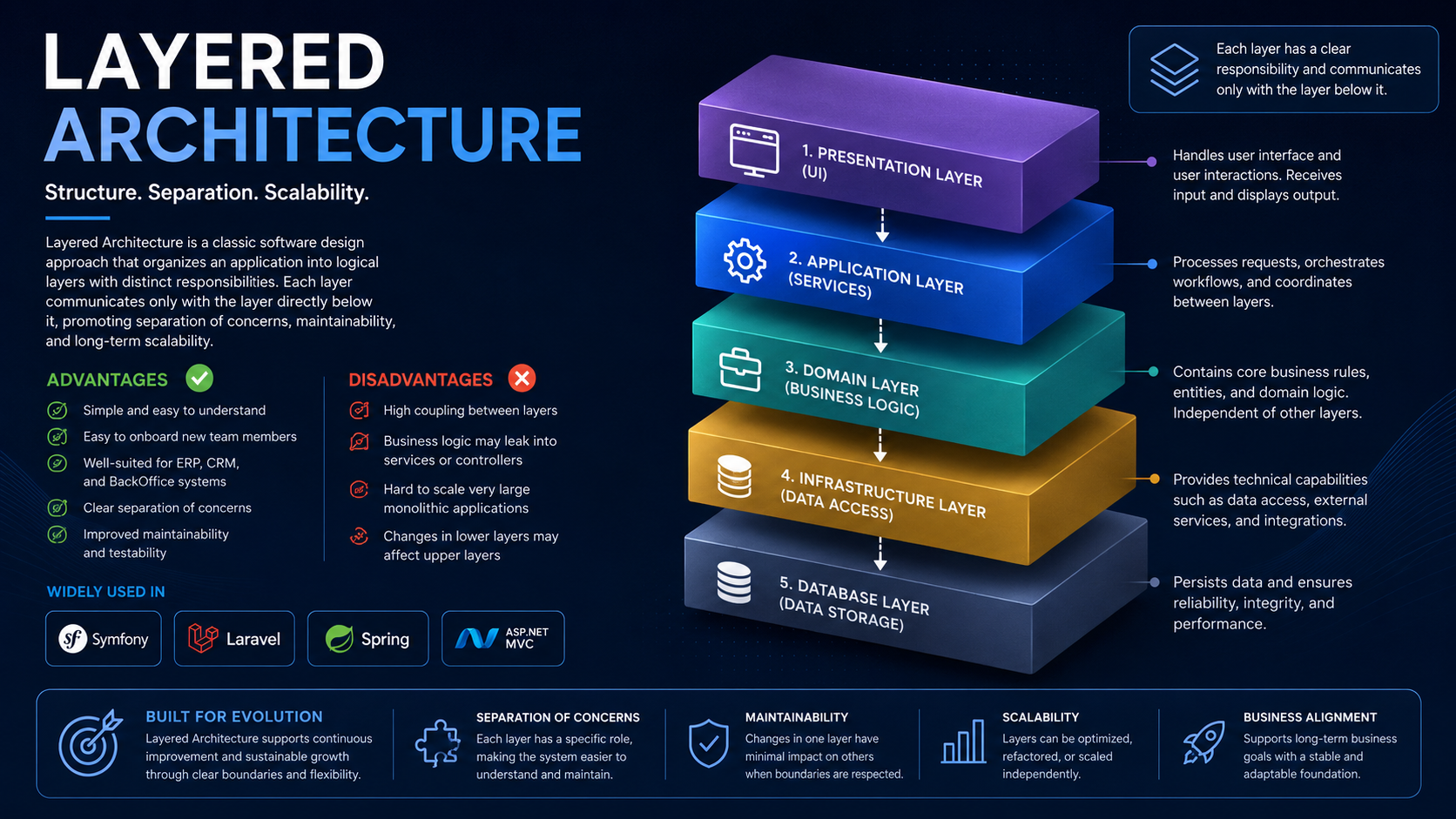
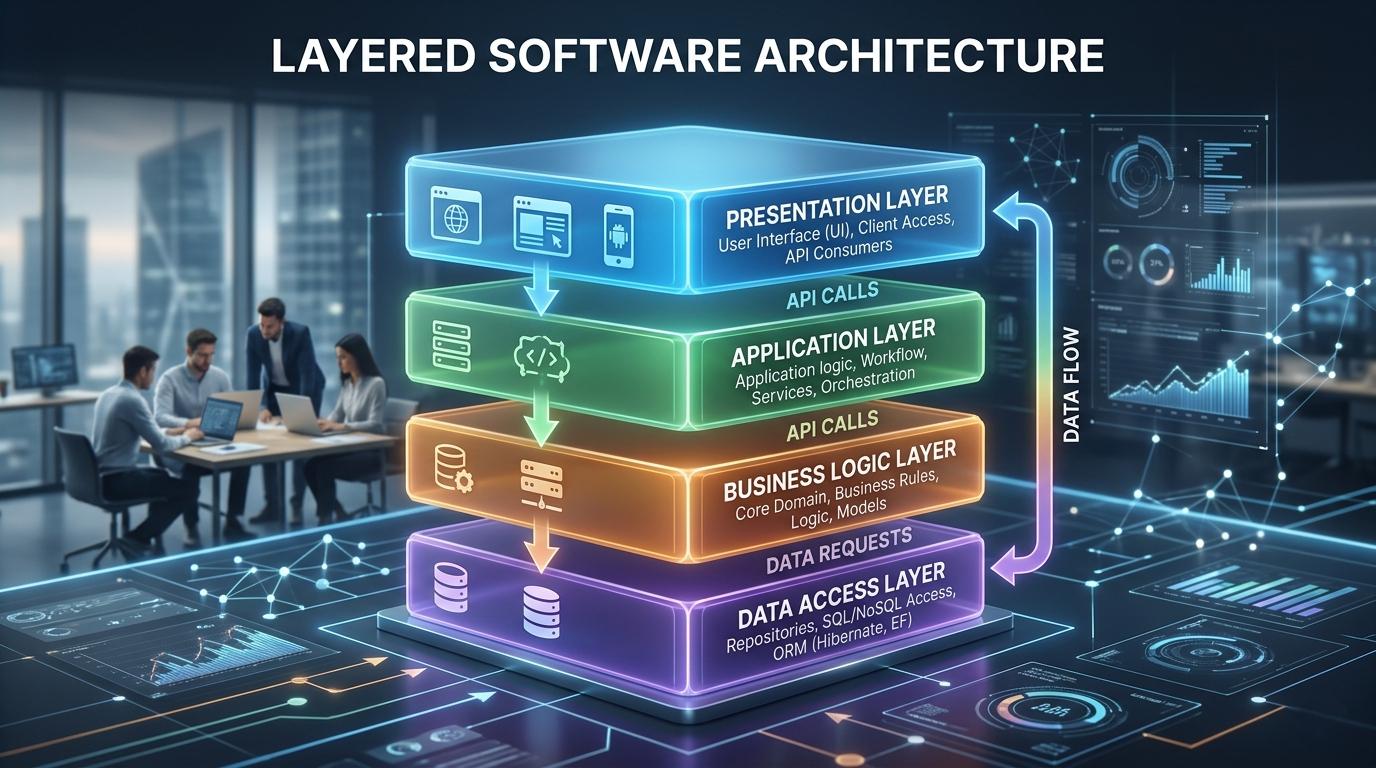
Layered Architecture is a model for organizing software systems in which an application is divided into several logical layers. Each layer is responsible for its own area of concern and usually communicates only with neighboring layers. This approach reduces chaos in the codebase, improves system readability, and simplifies task distribution among developers.
The classical structure of layered architecture usually includes the Presentation Layer, Application Layer, Domain Layer, Infrastructure Layer, and Database Layer. In real-world projects, the number of layers may vary depending on product scale, business requirements, and team maturity. However, the core principle remains the same — each part of the system should perform a clearly defined role.
Typical System Layers
The Presentation or UI layer is responsible for user interaction. This is where web interfaces, REST APIs, mobile views, forms, controllers, and data rendering mechanisms are located. This layer should not contain complex business logic, although in practice architectural discipline often starts breaking here.
The Application Layer or Service Layer manages the system’s use cases. It coordinates operations, controls transactions, invokes business logic, and organizes communication between components. This layer can be compared to a dispatcher managing process flows inside the system.
The Domain Layer is the core of the system. It contains business rules, entities, domain models, calculation algorithms, and the product’s essential logic. This layer defines the business value of the software because it reflects real company processes.
The Infrastructure Layer handles external systems and technical mechanisms. This layer includes databases, file systems, integrations, message queues, SMTP services, external APIs, and other technical dependencies. Its goal is to isolate technical details from business logic.
Why This Architecture Became a Standard
Layered architecture became extremely popular because of its predictability. A new developer only needs to understand the layer structure to quickly navigate the project. This is especially important for large enterprise teams where onboarding speed directly affects development costs.
Another success factor was support from popular frameworks. Symfony, Laravel, Spring Framework, ASP.NET MVC and many other frameworks were originally built around the layered model. As a result, thousands of companies around the world began to automatically use this approach as an industry standard.
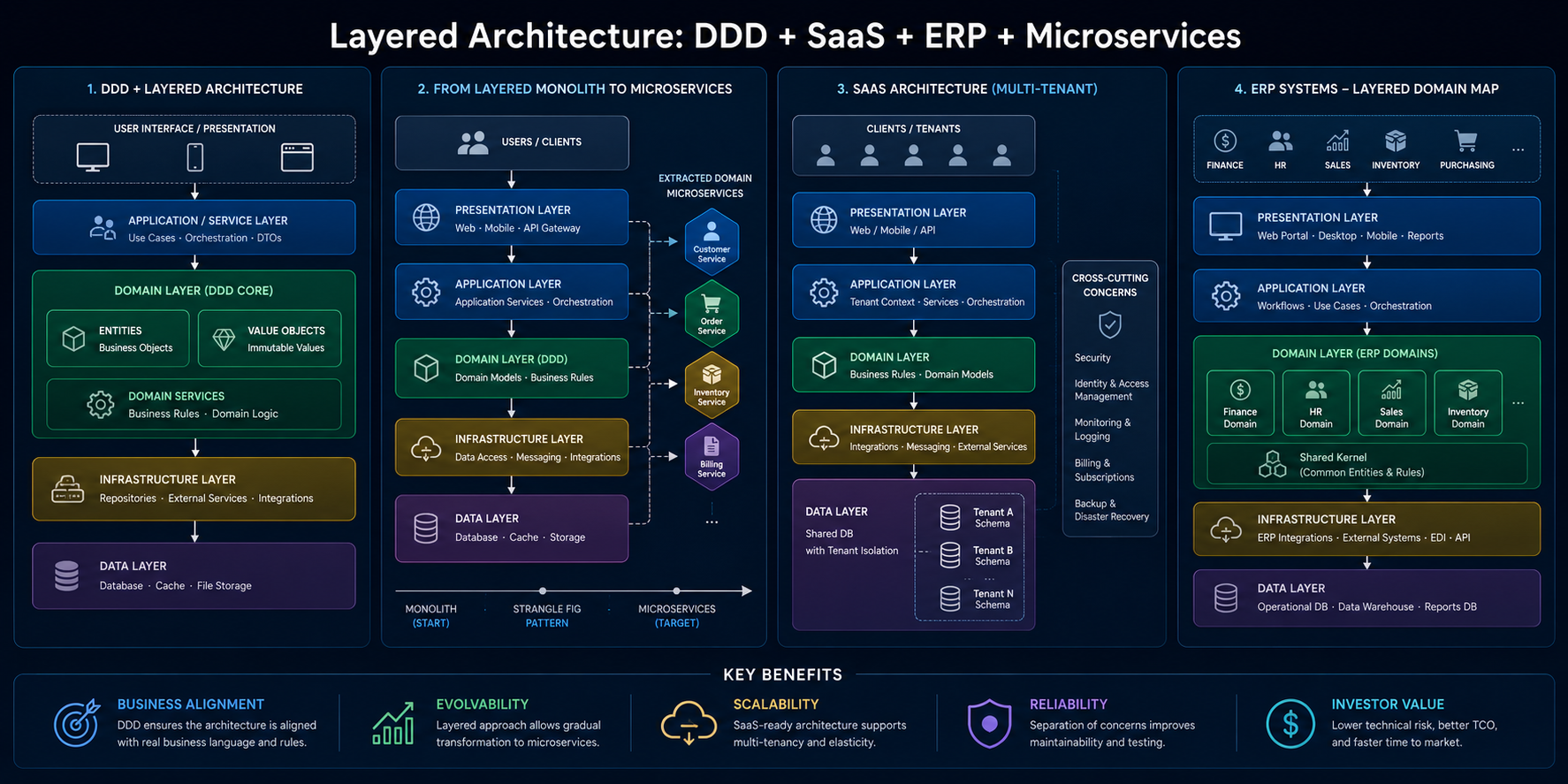
Layered Architecture historically became the foundation for most ERP and enterprise platforms because it naturally mirrors the structure of real businesses: user interfaces, application services, business rules, integrations, and data storage are separated into distinct layers of responsibility. This separation later became one of the foundations for Domain-Driven Design, where the business domain is treated as the central value of the system and architecture begins evolving around domain models rather than technologies. As a result, DDD does not replace Layered Architecture — it matures it, adds discipline, and aligns it more closely with business meaning and operational strategy.
For SaaS platforms, Layered Architecture became a critical transition stage between traditional monoliths and distributed cloud-native ecosystems. Most mature SaaS products originally started as layered monolithic systems because this approach allowed companies to launch quickly, control complexity, and maintain engineering stability during rapid growth. As workloads, customer bases, and integrations expanded, individual layers and domain modules were gradually extracted into independent services. That is why modern microservices are, in many ways, the evolutionary continuation of a well-structured layered monolith rather than its complete opposite.
From the perspective of the Kaizen philosophy, Layered Architecture is valuable not because it is “perfect,” but because it enables continuous system evolution without destroying its foundation. It allows teams to improve individual layers gradually, optimize business processes, reduce technical debt, and implement changes through controlled iterations. For designers, this approach provides predictable user experience and interface stability; for product teams, it creates the ability to evolve functionality without constant architectural crises; and for investors, it reduces technological risks while increasing long-term product sustainability. As a result, architecture becomes more than just a technical structure — it turns into a strategic instrument for company growth. That is why many mature ERP, CRM, and enterprise platforms still rely on the layered model even decades after its introduction.
“Philosophy Kaizen”