Hexagonal Architecture as a Tool for Technological Evolution
Modern digital systems are becoming increasingly complex. Businesses expect rapid development, resilience to change, scalability, and seamless integration with dozens of external services. At the same time, teams face constant shifts in technologies, APIs, cloud platforms, and user expectations. Under such conditions, software architecture is no longer just a technical concern — it becomes a strategic tool for managing risk, product evolution speed, and the cost of change.
Hexagonal Architecture emerged as a response to the problem of tight coupling between business logic and infrastructure. Databases, user interfaces, REST APIs, message brokers, and external services evolve over time, but the core business rules of a product should remain stable and independent. This idea became the foundation of the approach also known as Ports and Adapters Architecture.
The concept was introduced by Alistair Cockburn, a well-known software architect and one of the contributors to the Agile movement. In the early 2000s, he noticed that most enterprise systems gradually evolved into monolithic structures where business logic became tightly mixed with storage details, UI code, and integrations. This made systems expensive to maintain and extremely difficult to evolve.
Cockburn’s core idea was that the heart of the system should be isolated from the outside world. User interfaces, databases, file systems, or external APIs are merely delivery mechanisms for sending data into the system and receiving results back. Business logic should not depend on these details because they constantly change.
The term “hexagonal” is not about geometry but about visualization. The hexagon was used as a convenient diagram to demonstrate that a system may have multiple interaction points with the outside world. Unlike traditional layered architecture, there is no rigid distinction between “top” and “bottom.” Every external interface is treated as a separate adapter.
In practice, the number of sides can be anything. A system may expose REST APIs, GraphQL, CLI interfaces, mobile applications, message brokers, ERP integrations, web interfaces, and automated tests. All of them connect to the core through standardized ports.
Core Architectural Elements
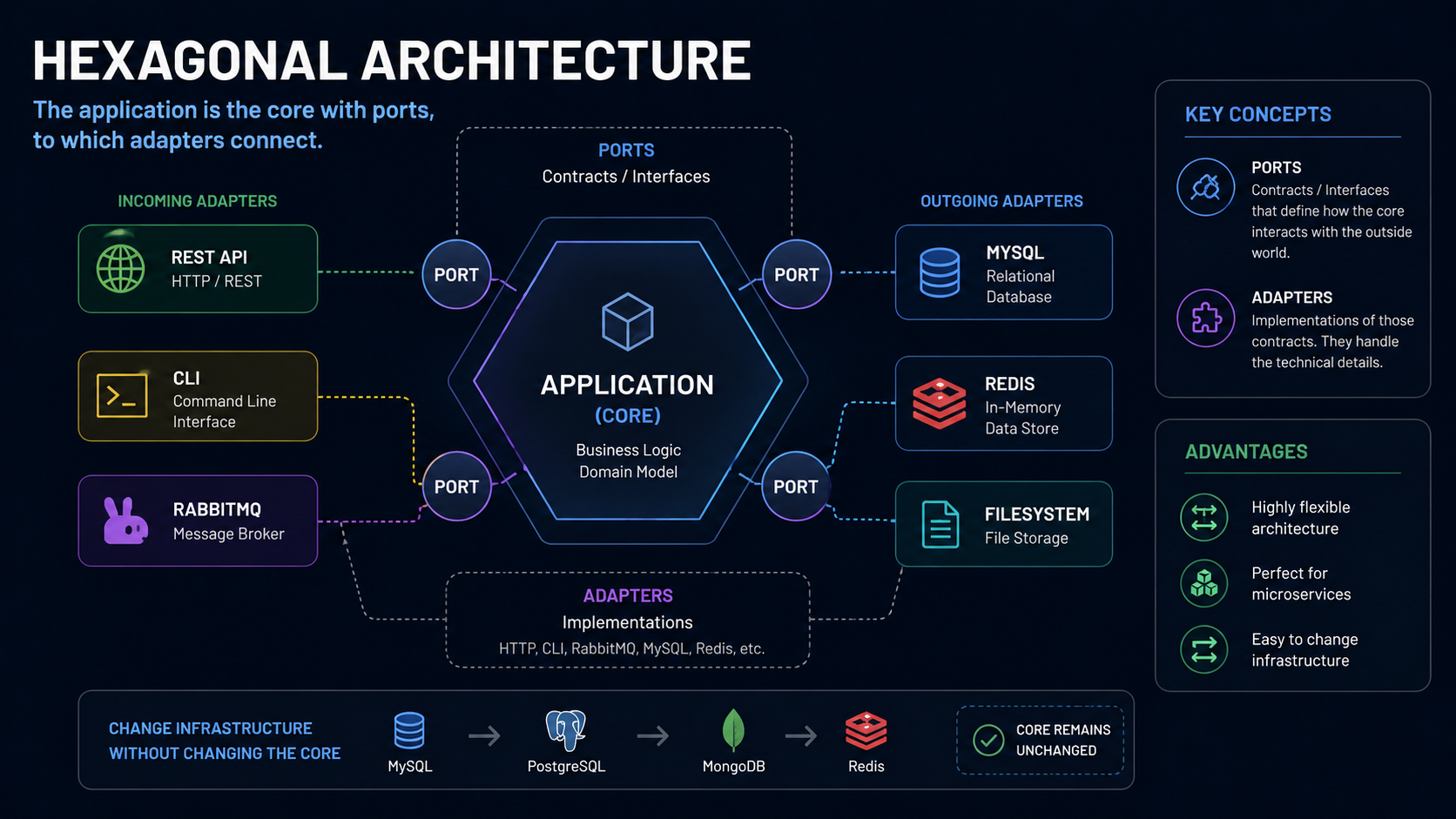
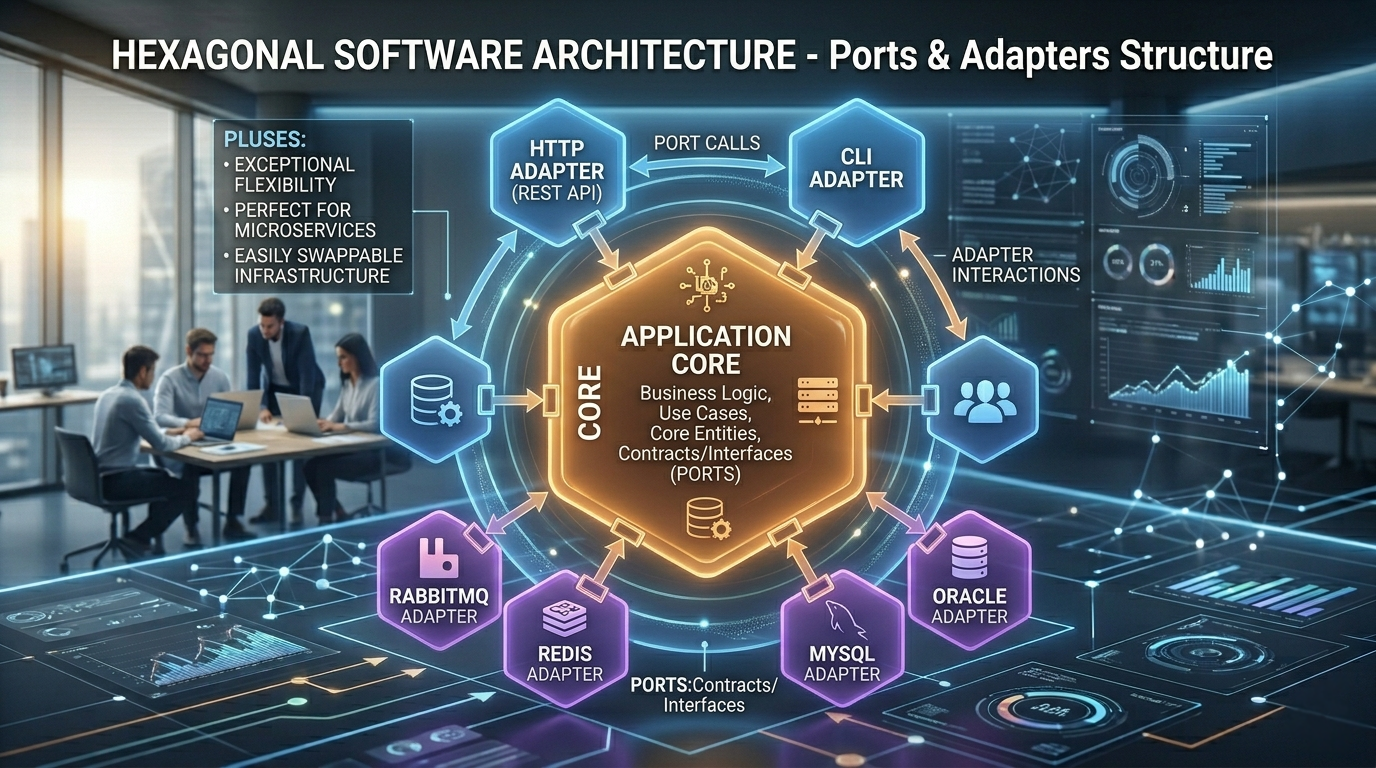
The system core contains business logic and domain rules. This is where use cases, entities, business processes, and key product constraints reside. The core should not know where data is stored, how the user interface looks, or how information enters the system.
Ports are interaction contracts between the core and the outside world. They describe what actions the system supports and what data is required to execute them. Ports are typically implemented through interfaces or abstractions.
Adapters connect external technologies to system ports. For example, an HTTP controller could be an adapter for a REST API, while a Doctrine or Entity Framework repository could be an adapter for a database. When replacing technology, only the adapter changes, but the core remains unchanged.
Ports & Adapters as a Model of Resilience
The Ports & Adapters concept treats an application as an independent core surrounded by replaceable channels of interaction with the outside world. Ports define interaction contracts and rules, while adapters enable different technologies — REST APIs, mobile apps, message queues, databases, or AI services — to connect without changing the business logic.
The primary advantage of Ports & Adapters lies in the independence of the system core from infrastructure and technology choices. Companies gain the ability to modernize platforms incrementally by replacing individual adapters without disrupting business operations or endangering the domain model. This approach is especially valuable for ERP, SaaS, and enterprise systems where the cost of downtime and architectural mistakes is extremely high. In the context of Kaizen, architecture becomes a tool for cumulative improvement: every small optimization of interfaces, integrations, or infrastructure strengthens the system without destroying the product value already created.
However, high flexibility comes at a cost. Ports & Adapters requires engineering discipline, architectural maturity, and additional effort to design interfaces, contracts, and adapters. For smaller products, such architecture may appear excessive because it increases system complexity from the very beginning. Yet through the lens of Kaizen, this is viewed as an investment in sustainable evolution: the longer a product lives and the faster the market changes, the more valuable an architecture becomes that can adapt without accumulating critical technical debt.
The Relationship Between Hexagonal Architecture and DDD
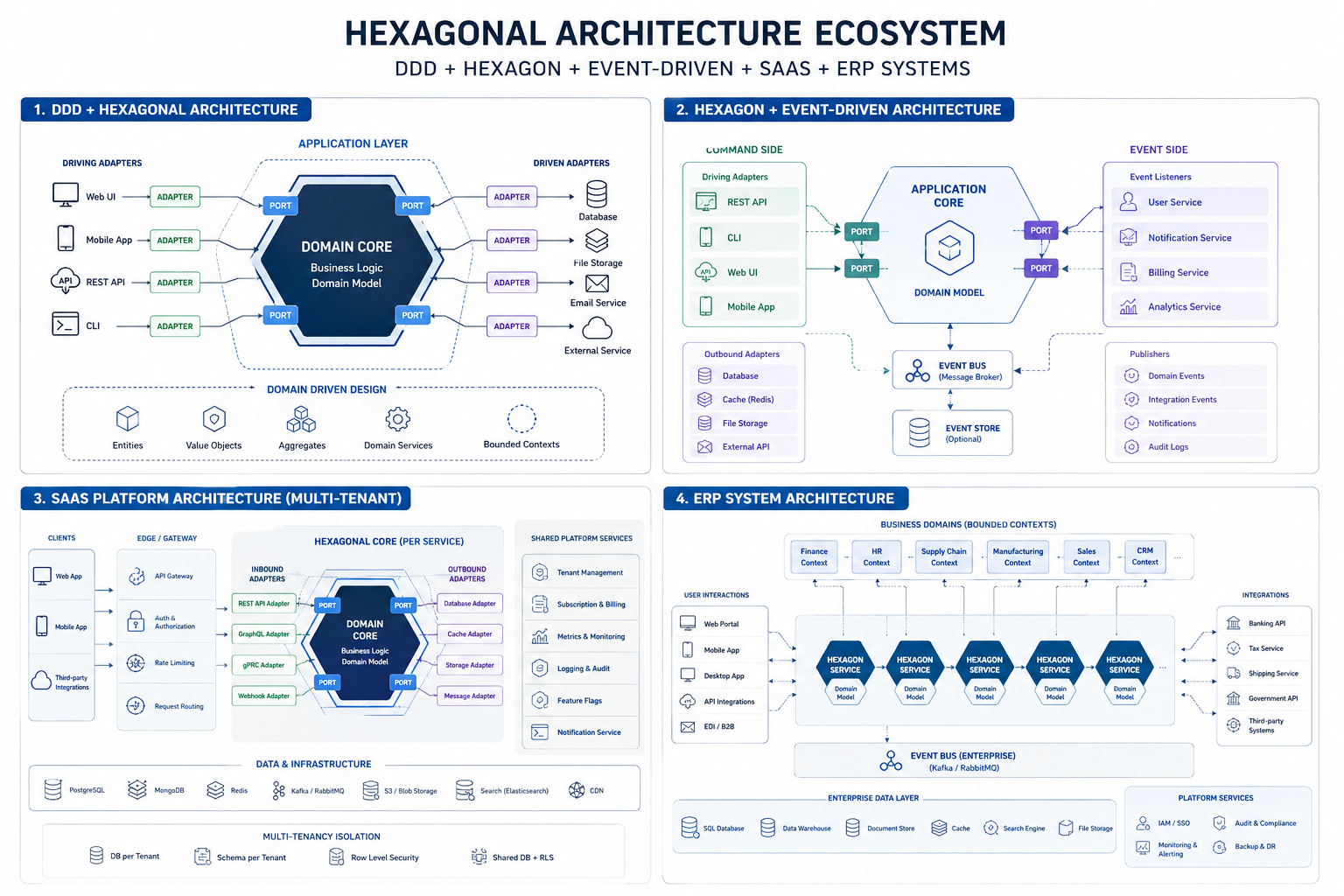
Hexagonal Architecture and Domain-Driven Design naturally reinforce each other. DDD helps model complex business domains through entities, aggregates, bounded contexts, and ubiquitous language, while Ports & Adapters isolates that model from infrastructure concerns. As a result, the system core reflects real business processes rather than technology choices. Through the lens of Kaizen, this approach enables continuous refinement of both the domain model and the architecture without disruptive rewrites, preserving product resilience amid evolving markets, interfaces, and integrations.
For SaaS platforms, Hexagonal Architecture becomes the foundation for continuous scalability and adaptation. The SaaS model requires constant delivery of new features, integrations, interaction channels, and monetization mechanisms while keeping the system stable for thousands of customers simultaneously. Ports & Adapters enables infrastructure, APIs, and external services to evolve without disrupting core business operations. In the context of Kaizen, architecture becomes a mechanism for cumulative growth, where every new integration or interface improvement contributes to the long-term evolution of the platform rather than triggering a technological crisis.
ERP systems are especially sensitive to architectural mistakes because they combine multiple business domains: finance, logistics, CRM, manufacturing, document workflows, and analytics. Hexagonal Architecture combined with DDD enables these areas to be separated into independent bounded contexts while preserving overall platform integrity. For architects, this means manageable complexity; for product teams, faster module evolution; and for investors, lower risks of system degradation during business scaling. Through the lens of Kaizen, ERP evolves from a heavy monolith into a living ecosystem capable of gradual and predictable growth.
Microservices as an Evolution of Architectural Thinking
In the world of microservices, Ports & Adapters becomes more than a pattern — it becomes a principle of service autonomy. Each service owns its own core, domain model, and integration adapters, reducing coupling between teams and enabling faster independent releases. However, increased flexibility also introduces the complexity of distributed systems: orchestration, observability, event-driven communication, and data management require mature engineering culture. That is why Kaizen plays a critical role here — resilient distributed systems are built not through radical revolutions, but through continuous improvements in architecture, processes, and team collaboration.
Through the lens of Kaizen, Hexagonal Architecture demonstrates that resilient digital products are built not through one-time technological decisions, but through a system’s ability to continuously adapt to changing markets, interfaces, and business models. For designers, this means the freedom to evolve user experiences without disrupting the product core; for product teams, it enables faster delivery of new workflows and integrations; and for investors, it reduces transformation costs and long-term technology risks. In this model, architecture becomes more than an engineering structure — it turns into a strategic business asset that directly impacts scalability, resilience, and the speed of growth. The faster the digital world evolves, the more valuable systems become that can improve incrementally while maintaining stability and control over complexity.
“Philosophy Kaizen”