Mapping Biology to Software Systems
The modern software industry has reached a level of complexity where classical engineering approaches are gradually approaching the limits of their effectiveness. Distributed systems, ERP platforms, cloud-native SaaS ecosystems, and AI infrastructures can no longer be viewed simply as collections of isolated services or independent modules. They are becoming living digital ecosystems in which thousands of components interact, adapt, and evolve simultaneously. This is why biology is no longer just a metaphor — it is becoming an engineering reference model for the next generation of architecture.
A biological cell represents one of the most sophisticated distributed systems ever created by nature. Over billions of years, evolution has shaped an architecture capable of scalability, resilience, autonomy, self-recovery, and continuous adaptation to changing environments. Many principles that the modern IT industry is attempting to achieve through cloud-native platforms, event-driven systems, and self-healing infrastructure have already existed inside biological systems for an immense period of time.
When viewed through the lens of software engineering, it becomes remarkably clear how deeply biology and distributed computing follow the same principles. Each cell functions as an autonomous computational unit with its own data model, decision-making mechanisms, security boundaries, resource management, and communication with the external environment. At the same time, the cell remains part of a larger organism, coordinating its behavior with other cells without relying on rigid centralized control.
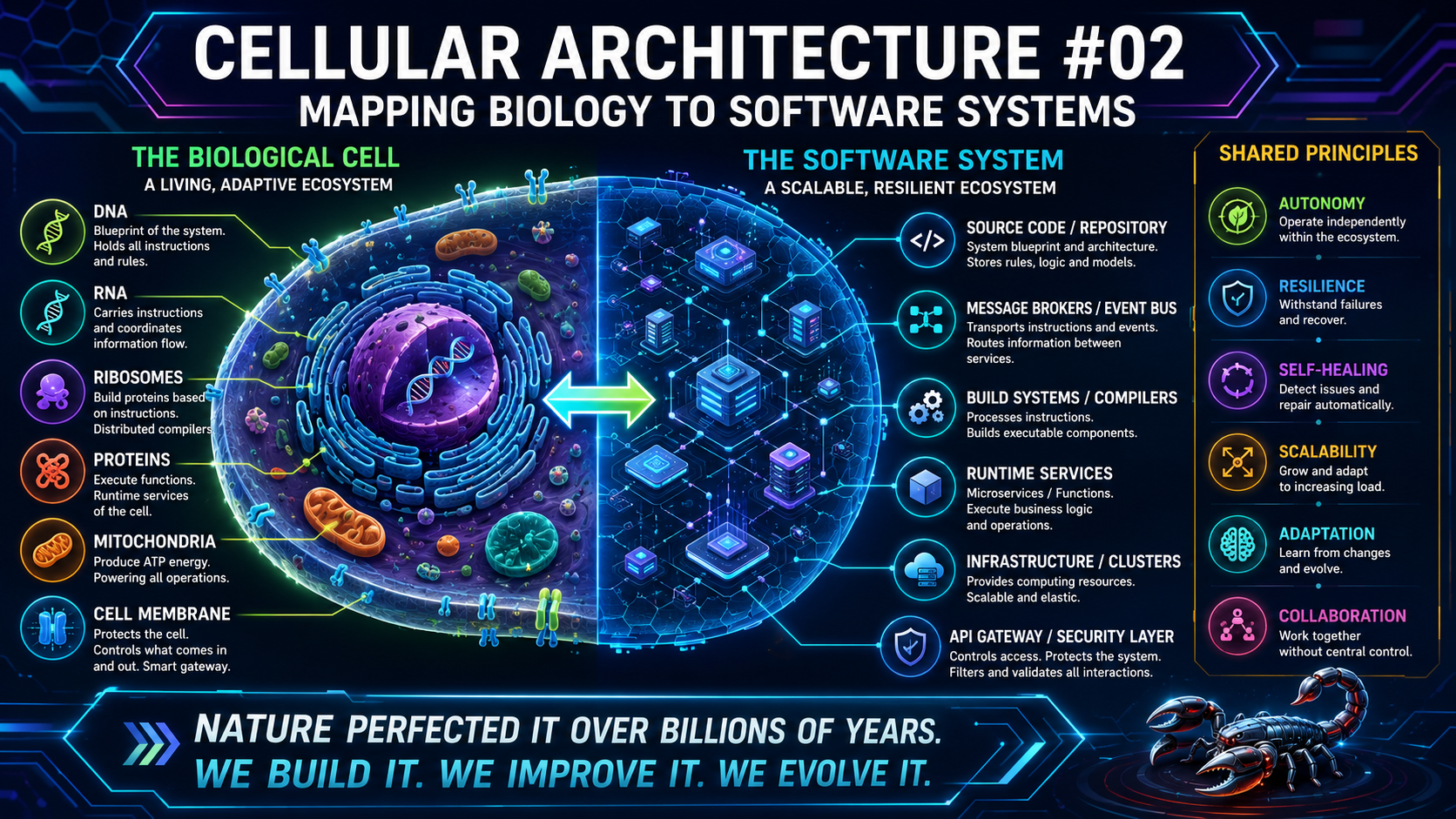
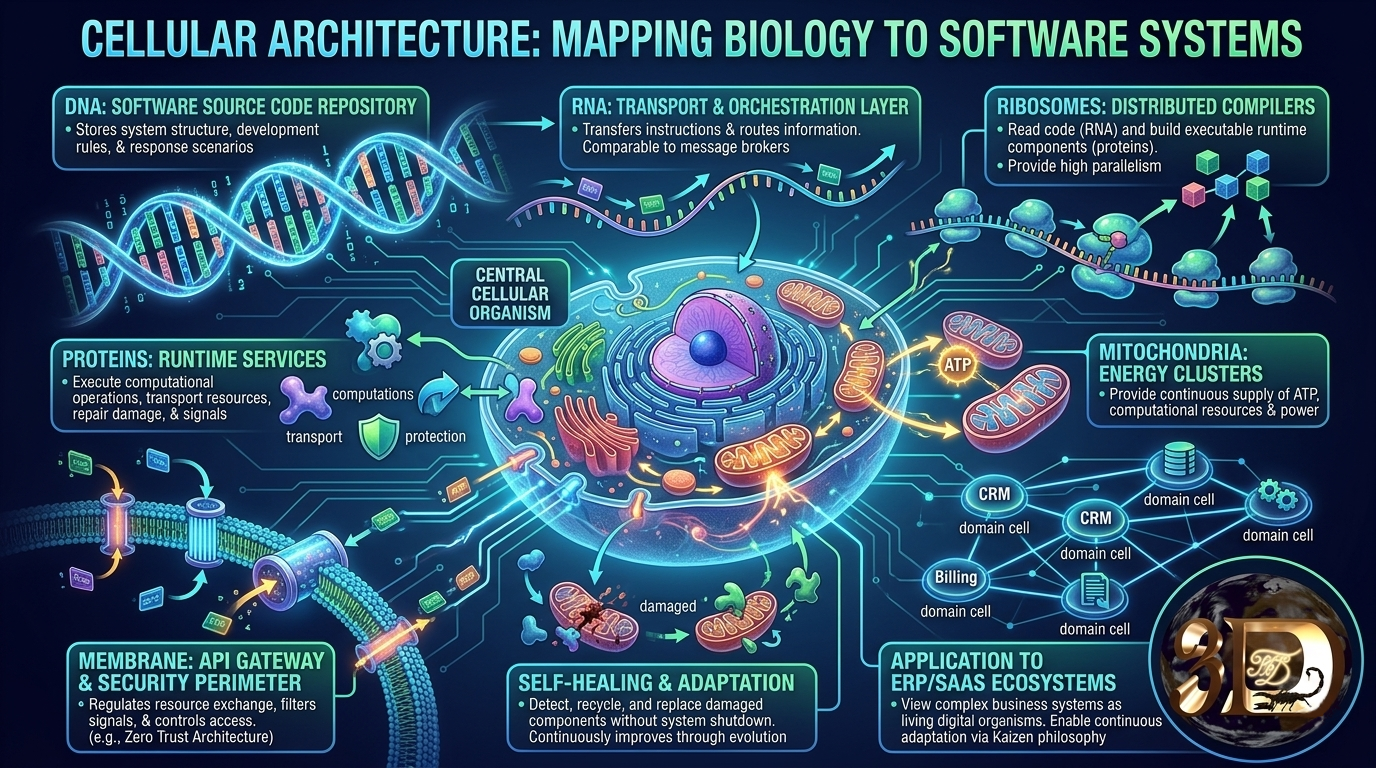
DNA within biological systems can be interpreted as the equivalent of source code and the architectural repository of the system. It stores not only the structure of the current state but also development rules, adaptation mechanisms, and response scenarios for environmental changes. Importantly, DNA is rarely used directly — information passes through multiple transformation stages before becoming executable action. This strongly resembles modern CI/CD pipelines, where source code goes through compilation, build, testing, and deployment stages before reaching production environments.
RNA in this model becomes the transport and orchestration layer of the system. It transfers instructions, routes information, and provides communication between persistent storage and execution mechanisms. In distributed computing, a similar role is played by message brokers, event buses, and asynchronous communication systems that enable services to exchange events efficiently.
Ribosomes can be viewed as distributed compilers and build systems. They continuously receive instructions and transform them into executable structures — proteins. Thousands of ribosomes operate simultaneously within a single cell, creating an extraordinary level of parallelism and performance. In modern IT infrastructure, this resembles scalable orchestration platforms capable of dynamically generating runtime components whenever they are required.
Proteins themselves act as the runtime services of the cell. They perform computations, transport resources, protect the system, process signals, repair damage, and execute nearly all active operations. Some proteins exist permanently, while others are generated dynamically only under specific conditions. This model closely resembles modern serverless architectures and event-driven execution systems.
Mitochondria function as the energy clusters of the system. No distributed platform can operate without a continuous supply of computational resources and energy. Within the cell, this role is performed by mitochondria producing ATP — the universal energy currency of biological systems. In the IT world, a comparable role is played by data centers, cloud infrastructure, and resource orchestration platforms.
The cellular membrane acts simultaneously as an intelligent API Gateway and a security perimeter. It filters incoming signals, regulates resource exchange, controls access, and protects the internal environment of the system. Modern API Gateway solutions, Zero Trust Architecture, and service mesh approaches are effectively moving toward principles that biology has utilized for billions of years.
One of the most remarkable characteristics of cellular systems is self-healing capability. Damaged components are automatically detected, recycled, and replaced without shutting down the entire system. Furthermore, cells can adapt to environmental changes and gradually evolve over time. These are precisely the capabilities modern AI systems, autonomous platforms, and cloud-native infrastructures are attempting to replicate.
For ERP platforms and SaaS ecosystems, this model becomes especially relevant. Modern business systems are no longer “monolithic applications” in the traditional sense. They are evolving into complex digital organisms where CRM, accounting, projects, billing, analytics, and tenant infrastructures must operate as interconnected yet autonomous subsystems. Cellular Architecture proposes viewing such systems not as collections of modules, but as living ecosystems capable of continuous adaptation and evolution.
From the perspective of kaizen philosophy, the biological model is especially important because nature rarely relies on radical one-time transformations. Evolution is built upon continuous improvement, gradual adaptation, and constant optimization without destroying system integrity. For software architecture, this represents a transition from designing “finished systems” toward creating architectures capable of continuously evolving, learning, and strengthening their own resilience. This is why the future of high-load ERP, SaaS, and AI platforms increasingly resembles not mechanical systems — but living organisms.
“Philosophy Kaizen”